
Why it is called a Jesse Tree
Jesse lived in Bethlehem. He was the father of King David (1 Samuel 16:1–13), and his grandmother was Ruth (Ruth 4:17). Many years after David, the prophet Isaiah gave God’s people a promise in the shape of a tree:
“A shoot will come out of the stock of Jesse, and a branch out of his roots will bear fruit.”
Isaiah 11:1
A stock is the stump left after a tree is cut down. Isaiah pictures a green shoot growing out of that stump: new life from Jesse’s family when it looked as if nothing more could grow. Christians read the promise as pointing to Jesus, and Matthew’s Gospel names Jesse in Jesus’ family line (Matthew 1:5–6).
So a Jesse Tree is not a strict family tree. It is the story of that promise, told one person or one moment at a time, from Creation to the manger, with an ornament for each.
Where the Jesse Tree comes from
The Jesse Tree began as a picture. For centuries, church artists drew Isaiah’s words as a real tree. In the usual picture, Jesse lies asleep at the bottom, a tree grows up out of him, kings from his family sit in the branches, and Mary and Jesus are at the top. You can find it in stained glass windows in old cathedrals, in carved stone, and in illuminated manuscripts, the hand-lettered and hand-painted Bibles and prayer books of the Middle Ages.
The ornament tree is a newer and simpler custom. Families and churches took the old picture and made it something to do through Advent: a small tree, a symbol for each story, and one reading a night. There is no single official list. Each church, family and publisher chooses its own stories and symbols, so two Jesse Trees rarely match exactly.
The 25 Jesse Tree stories, day by day
This is the list we use, from Creation on December 1 to the wise men on Christmas Day. Where we have a free retelling of the story, the name links to it.
- Day 1CreationGenesis 1:1–2:3
- Day 2The first promiseGenesis 3:1–15
- Day 3NoahGenesis 6:9–9:17
- Day 4AbrahamGenesis 15:1–6
- Day 5IsaacGenesis 22:1–14
- Day 6JacobGenesis 28:10–22
- Day 7JosephGenesis 37; 45:4–8
- Day 8MosesExodus 3:1–12
- Day 9The Ten CommandmentsExodus 19:3–6; 20:1–17
- Day 10RuthRuth 1:16; 2:1–12; 4:13–17
- Day 11JesseIsaiah 11:1–2
- Day 12David1 Samuel 16:1–13
- Day 13Solomon1 Kings 3:5–12
- Day 14Elijah1 Kings 18:20–39
- Day 15IsaiahIsaiah 9:2, 6–7
- Day 16JonahJonah 1:1–3:10
- Day 17DanielDaniel 6
- Day 18MicahMicah 5:2
- Day 19Zechariah and ElizabethLuke 1:5–25, 57–64
- Day 20MaryLuke 1:26–38
- Day 21JosephMatthew 1:18–25
- Day 22The trip to BethlehemLuke 2:1–5
- Day 23The shepherdsLuke 2:8–20
- Day 24Jesus is bornLuke 2:6–7
- Day 25The star and the wise menMatthew 2:1–12
Day 12 is the day Samuel anoints David. Our free story David and Goliath picks up in the next chapter, 1 Samuel 17.
Our printable Jesse Tree Advent Countdown follows these same 25 days, with an ornament and a read-aloud card for each one. The first week, Creation to Joseph, is free to print: try the first week free.
How to do a Jesse Tree at home
About five minutes a night, starting on December 1.
- 01
Choose a tree
A bare branch in a jar, a small tabletop tree, or a paper tree taped to the wall or the fridge. Put it where your family gathers in the evening.
- 02
Have the ornaments ready
One simple symbol for each story: a rainbow for Noah, stars for Abraham, a lion for Daniel, a manger on Christmas Eve. Draw them on card, cut them from felt, or print a set.
- 03
Read the story aloud
Read the day’s passage from your Bible, or a children’s retelling of the same story. For the youngest, a few verses are plenty.
- 04
Hang it and pray
Let a child hang the ornament. Ask one question about the story, then close with a one-line prayer.
Families do it differently, and that is fine. Some start on the first Sunday of Advent instead of December 1. Some read only a verse or two on busy nights. Some keep the ornaments in a box and bring them out again every year. If you miss a night, read two stories the next evening.
In a classroom or Sunday school, read the day’s story at circle time and let one child hang the ornament; our church and classroom license ($15) covers printing a set for your class.
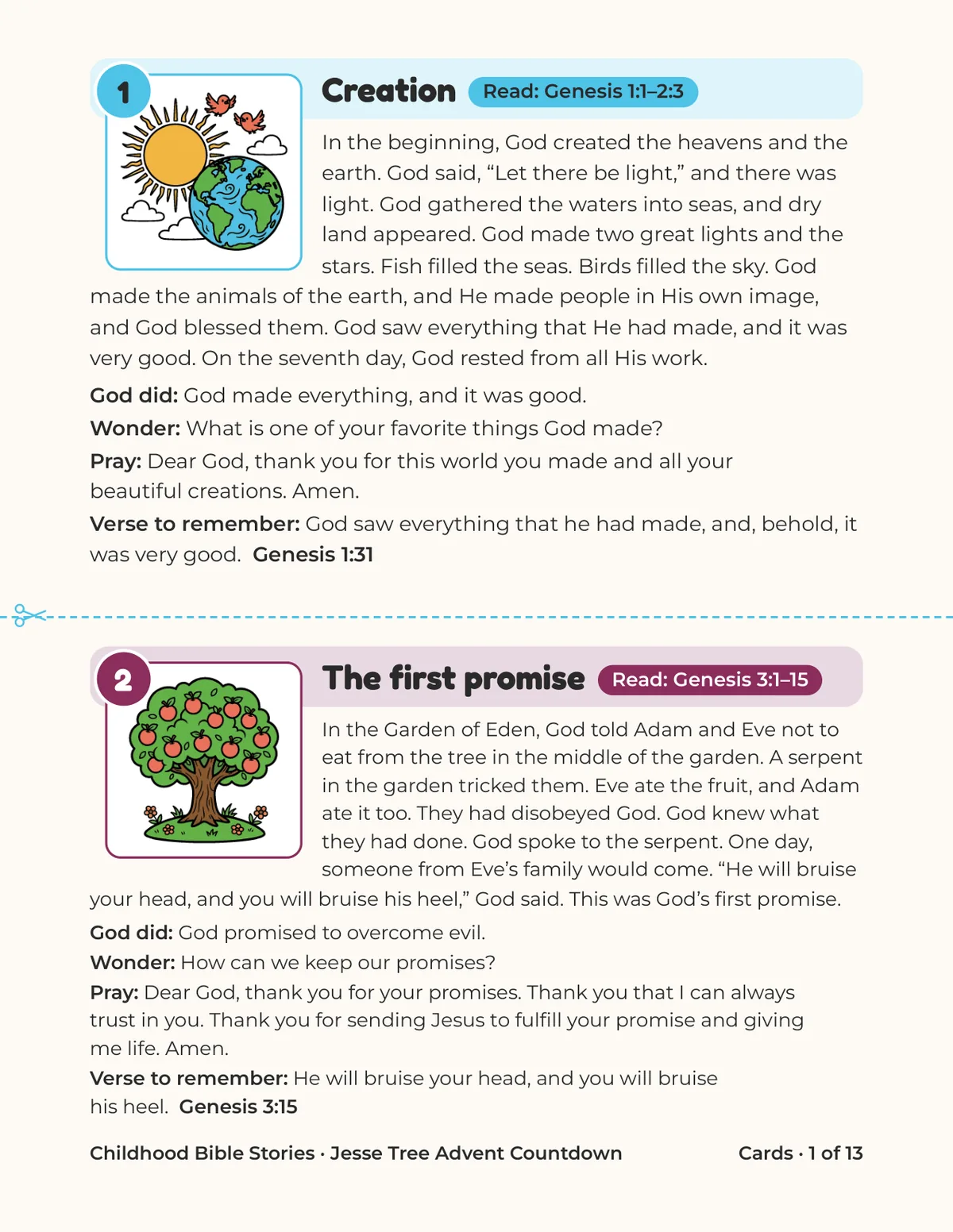
The Jesse Tree Advent Countdown
The 25 days above, ready to print. Each day has an illustrated ornament to cut out and hang, the passage to read, a short read-aloud retelling, a wonder question, a prayer and a verse to remember. There is a tree poster to hang them on and a reading plan for the fridge, in US Letter and A4, in color and low ink.
Jesse Tree questions
How many ornaments are on a Jesse Tree?
Usually around 25, one for each day from December 1 to Christmas Day. Families who start on the first Sunday of Advent need a few more or a few fewer, because that Sunday moves from year to year, and some lists add extra stories. Ours has 25, one for each day in the list on this page.
When do you start a Jesse Tree?
Either on December 1, so the last ornament goes up on Christmas Day, or on the first Sunday of Advent, which falls between November 27 and December 3. In 2026 that Sunday is November 29. Our list starts on December 1, so it begins on the same date every year.
What is the difference between a Jesse Tree and an Advent calendar?
An Advent calendar counts the days to Christmas, often with a little door, a picture or a small treat for each day. A Jesse Tree counts the days too, but each day is a Bible story and an ornament, and together the stories tell how God kept His promise from Creation to Bethlehem. Some families keep both.
Is the Jesse Tree Catholic or Protestant?
Both use it. The Tree of Jesse pictures come from church art made long before the Reformation, and today Catholic and Protestant families, churches and Sunday schools keep Jesse Trees. The stories come straight from the Bible, so it suits any family that wants to read Scripture together in Advent.
What age is a Jesse Tree for?
Many families start around age 3, when a child can hang an ornament and listen to a short story. By 6 to 8, children can read a verse aloud or look up the passage themselves. Older brothers and sisters, and grown-ups, can hear the whole story again alongside them.
For more to read in December, see our Christmas Bible stories, or find every one of our free Bible stories for kids in one place.