The Good Samaritan Bible Story for Kids.
The Good Samaritan is Jesus' famous answer to the question “Who is my neighbor?” A hurt traveler, two people who walk past, and one kind stranger who stops. It teaches children that kindness is for everyone, and that anyone can be the one who helps.
Retold by Hannah Whitford · Luke 10:25–37 · Updated September 2026
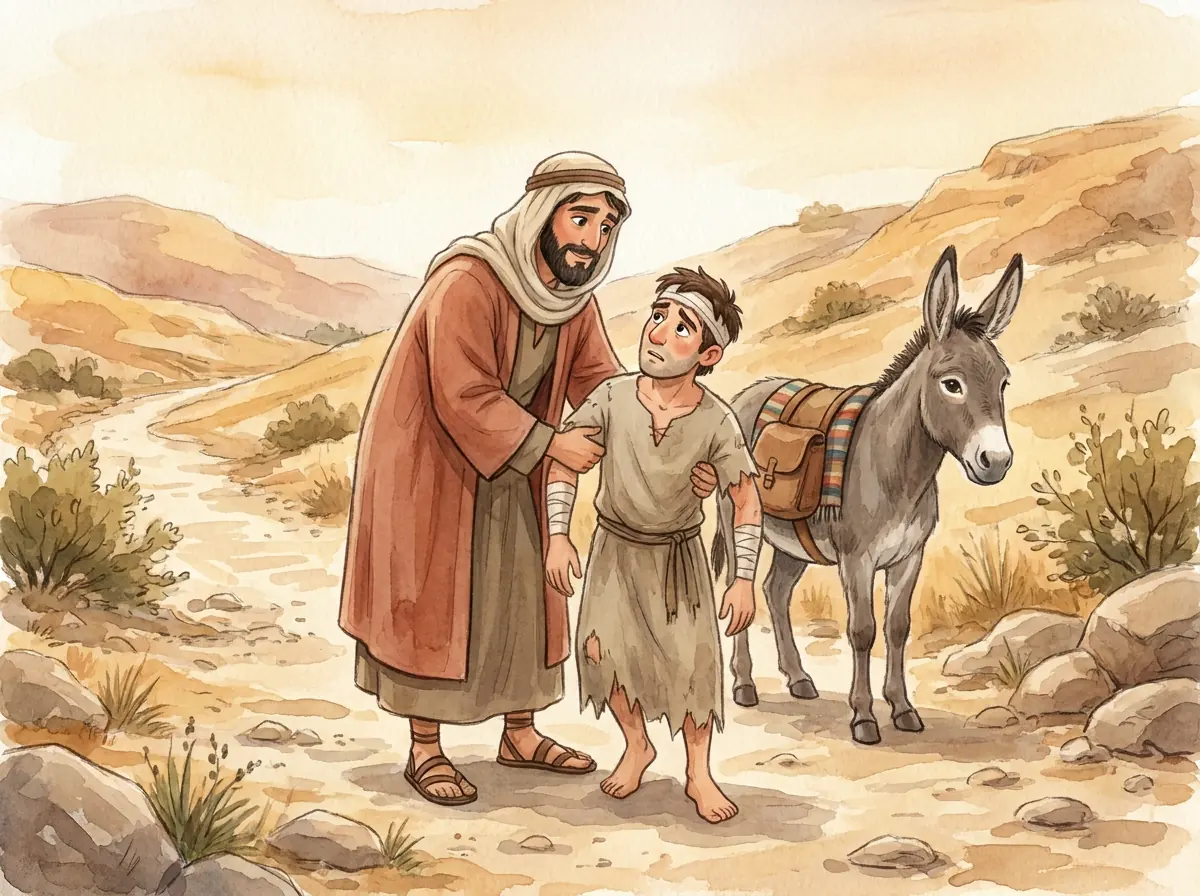
The Story of the Good Samaritan


“But a certain Samaritan, as he traveled, came where he was. When he saw him, he was moved with compassion, came to him, and bound up his wounds, pouring on oil and wine. He set him on his own animal, and brought him to an inn, and took care of him.”
Luke 10:33–34
“On the next day, when he departed, he took out two denarii, and gave them to the host, and said to him, ‘Take care of him. Whatever you spend beyond that, I will repay you when I return.’”
Luke 10:35
“He said, ‘He who showed mercy on him.’ Then Jesus said to him, ‘Go and do likewise.’”
Luke 10:37
Quotations from the World English Bible (public domain). Read the full passage together in your own family Bible. The reference is Luke 10:25–37.
“You shall love the Lord your God … and your neighbor as yourself.”
Luke 10:27
The man who questioned Jesus answered with these words, and Jesus told this story to show what they look like. Learn it together, then pick one neighbor to help this week.
World English Bible.
The Good Samaritan teaches children that a neighbor isn't just someone who lives nearby or is like us. A neighbor is anyone who needs kindness. Jesus wants us to notice people who are hurting and to be the one who stops to help, even when it costs us something.
- 01The kind helper and his own animal give children a hero to root for from the moment he appears.
- 02The pattern of three (two people walk past, one stops) is easy for even small children to follow and predict.
- 03The surprise that the least-expected person is the hero lands with kids just like it did with Jesus' first listeners.
- 04It ends with something to do: “go and do likewise” turns the story into a real-life game of spotting who needs help.


This story is one of twelve lessons in our Starter Pack.
Our Bible Story Lessons Starter Pack has twelve printable lessons for home or church. Try the Noah’s Ark lesson free: seven printable pages, sent to your inbox. See the Starter Pack →
We’ll also send a few emails over the next couple of weeks with lessons, printables and our books. Unsubscribe anytime.

The kind of things parents wonder.
What is a Samaritan, and why does it matter in this story?
A Samaritan was a person from Samaria, a region right next door to where Jesus' listeners lived. In those days, Jews and Samaritans didn't get along. They disagreed about important things and mostly avoided each other. That's the whole point of the story: Jesus deliberately made the hero the one person His listeners least expected. For a child, you can put it simply: “The helper was someone from a group people usually stayed away from, and he turned out to be the kindest one on the road.”
Where is the Good Samaritan story in the Bible?
It's in Luke 10:25–37. It's a parable (a teaching story Jesus told) given as His answer when a religious expert asked, “Who is my neighbor?” It only appears in Luke's Gospel.
What is the main lesson of the Good Samaritan for kids?
A neighbor is anyone who needs our help, not just people who live near us or are like us. The story ends with Jesus' own instruction (“go and do likewise”), so the lesson isn't just to admire the Samaritan's kindness but to copy it.
How do I tell the robber part without scaring my child?
Keep it to one gentle sentence: “Robbers hurt him and took everything he had, and he couldn't get up.” You don't need any detail beyond that. The Bible itself moves on quickly, and the story's attention goes to the helping, not the hurting. Most children accept it easily because the rescue comes so soon after.
What are the two coins the Samaritan gave the innkeeper?
Two denarii: a denarius was a silver coin worth about a full day's pay for a worker. So the Samaritan handed over roughly two days' wages and promised to pay even more on his way back. It's worth pointing out to kids: his kindness wasn't free. It cost him real money and real time, and he gave both.
What age is the Good Samaritan story good for?
It works from about age 3 up. Toddlers and preschoolers can follow the simple pattern: someone is hurt, two people walk past, one kind person stops. Older children (6–8) can dig into the bigger question Jesus was answering: who counts as my neighbor, and why did He make the hero someone the listeners didn't like?
How do you explain the Good Samaritan to a child?
Give the one piece of background first, in a sentence: a Samaritan was someone from a group that Jesus' listeners usually kept away from. Then count it on four fingers. A man walking a lonely road was robbed and hurt and left by the side of it. A priest came along and walked past on the other side. A temple helper came along and walked past too. Then a Samaritan came along, and he stopped, bound up the man's wounds, set him on his own animal, took him to an inn, and paid for him to be looked after. Finish with Jesus' own ending: go and do the same.
Who asked Jesus the question that started this story?
A lawyer, meaning an expert in the religious law rather than a courtroom lawyer. Luke says he stood up to test Jesus and asked what he should do to inherit eternal life (Luke 10:25). When Jesus turned the question back on him he answered correctly, love God and love your neighbour, and then asked a second question to narrow it down: who exactly counts as my neighbour? The parable is the answer to that second question, and it is much wider than he was hoping for.
Why did the priest and the Levite walk past the hurt man?
Luke does not tell us, which is worth admitting rather than filling in. All the text says is that each one saw him and passed by on the other side. People have suggested fear of robbers still nearby, or hurry, or worry about temple duties. The story does not need a reason, and that is part of its sting: walking past is ordinary. It does not take a villain, only someone with somewhere else to be.
Why does Jesus say the traveller was going 'down' to Jericho?
Because he was. Jesus begins with a man going down from Jerusalem to Jericho (Luke 10:30), and Jericho sits far lower than Jerusalem, so the road drops steeply the whole way through empty country. For a child, 'a steep lonely road with hardly anybody on it' is what makes being left at the side of it so serious. Help was never going to arrive quickly.
Why did Jesus change the question at the end of the story?
The lawyer asked who counts as my neighbour, which is a question about other people and where the boundary sits. At the end Jesus asks which of the three was a neighbour to the hurt man, which is a question about what you do. He moved the question from other people to the lawyer himself. Older children can feel that switch, and it is worth naming it: Jesus did not tell him who was on the list, He told him to go and be the kind of person who stops.
How can a preschooler actually practise this?
Make it small and same-day. Pick one person who needs something before bedtime and do that one thing together: a card for a neighbour who lives alone, helping a sibling find a lost toy, carrying something heavy for a grandparent. The Samaritan's kindness cost him time and money, so let your child's cost something too, even if that is only five minutes of play they would rather have had. Kindness a child has actually done outlasts kindness they have heard about.
Conversation starters.
Questions to ask after you read together. No right answers, just good conversation.
Why do you think the priest and the Levite walked past instead of stopping?
What did the Samaritan pour on the hurt man's wounds?
The Samaritan's kindness cost him time and money. Has being kind ever cost you something?
Jesus said, “Go and do likewise.” Who is someone we could be a good Samaritan to this week?
Teaching this story.
- 01Before you start, explain the one thing the story can't work without: “A Samaritan was someone from a group of people that the listeners' group didn't get along with; they usually avoided each other.” Ten seconds of setup is all it takes, and without it the twist is invisible to a child.
- 02Resist turning the priest and the Levite into bad guys. The story's real sting is that walking past is easy and ordinary. With older children you can even ask, gently, “Have you ever walked past someone who needed help? Me too.”
- 03Keep the robbers to one sentence (“robbers hurt him and took everything he had”) and move on. The story spends one verse on the hurting and five on the helping, and your telling should too.
- 04Make “go and do likewise” concrete the same day: pick one act of kindness together (a card for someone lonely, helping a sibling find a lost toy) and do it before bedtime while the story is still warm.
Bandage-Roll Kindness Kit
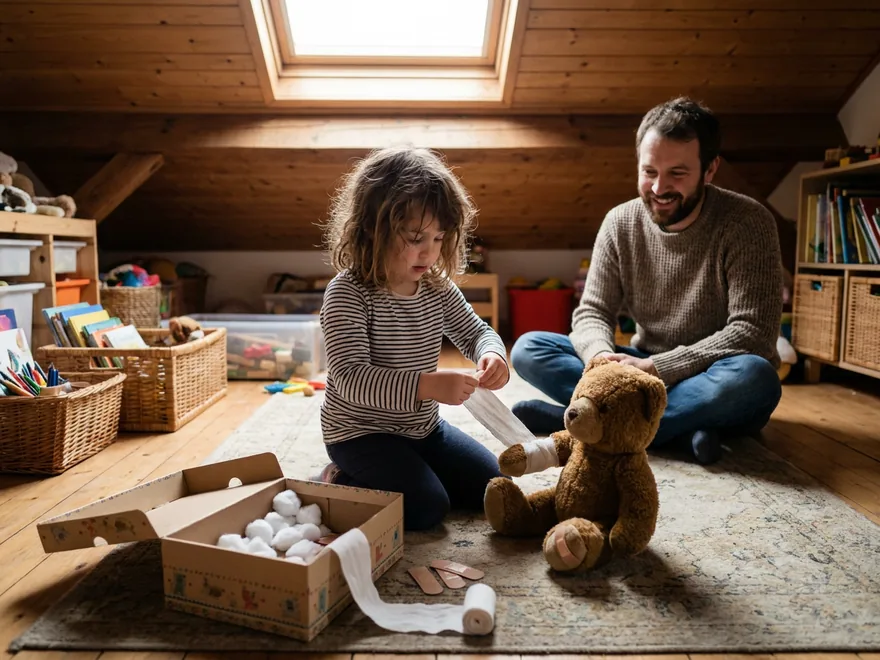
Decorate a small box or zip bag with your child and pack it like the Samaritan's saddle-bag: a few adhesive bandages, cotton balls, a rolled strip of an old white t-shirt for a “bandage roll,” and a coin or two like the two denarii. Then let your child play Good Samaritan: gently wrapping a teddy bear's arm, walking it to the “inn” (the sofa), and paying the innkeeper. Acting out the caring is what makes the story stick.
Folded Road Diorama

Fold a strip of cardboard or brown paper into a zigzag so it stands up like the steep road from Jerusalem down to Jericho. Add crumpled-paper boulders, a cotton-ball bush or two, and a paper inn at the bottom. Draw and cut out the traveler, the priest, the Levite, the Samaritan, and his animal, and let your child walk each one down the road as you retell the story, pausing to ask, “Will this one stop?”
Everything you need in one place.
Written for a parent at the kitchen table or a Sunday school helper with twenty minutes and a box of crayons.
Ages: 3 to 8. Threes and fours follow the pattern of hurt, walked past, stopped for. From about six a child can carry the Samaritan twist and the question Jesus was answering.
Read together: Luke 10:25–37 (WEB)
- A small box or zip bag, adhesive bandages, cotton balls, and a strip of old white cloth
- A strip of cardboard or brown paper, plus crumpled paper for boulders
- Scrap paper and scissors for the traveller, priest, Levite, Samaritan, and his animal
Will this one stop?
- Build the zigzag road and stand it on the floor or table, with the inn at the low end.
- Set the hurt traveller down halfway along and read Luke 10:30 aloud.
- Walk the priest to him, stop, and ask your child: will this one stop? Then walk him past.
- Do the same with the Levite. Let the disappointment land; do not soften it.
- Walk the Samaritan up, and this time let your child do the stopping, the bandaging, the loading onto his own animal, and the walk to the inn.
One kindness before bedtime
- Read Luke 10:36 and 37 together, and let your child say the last line: go and do likewise.
- Draw the neighbour map and mark the people who could use something.
- Pick exactly one, and pick it today rather than someday.
- Do it together before bedtime, and let your child hand it over or say the words themselves.
- At lights out, ask what it cost them. Then read verse 35 again, where the Samaritan pays and promises to pay more.
If the conversation stalls
Short model answers for the questions above. They are a starting point to offer if a child shrugs, not a script to read out.
Why do you think the priest and the Levite walked past instead of stopping?
The Bible does not tell us, so any thoughtful guess is fine: they were scared, they were busy, they told themselves someone else would come. The honest thing to add is that walking past is easy and none of us needs a reason to do it, which is exactly why Jesus put two of them in the story.
What did the Samaritan pour on the hurt man's wounds?
Oil and wine, and then he bandaged the wounds (Luke 10:34). The man had already been passed twice by people he would have expected to stop, and the one who helped him came from the group he would least have expected help from. Let your child count each thing the Samaritan did.
The Samaritan's kindness cost him time and money. Has being kind ever cost you something?
Go first with something small and true from your own week. Then help your child count what the Samaritan spent: his oil and wine, his own place on the animal, a night at the inn caring for him, two denarii, and a promise to pay whatever more it came to. In this story, kindness is an invoice he chose to pay.
Jesus said, “Go and do likewise.” Who is someone we could be a good Samaritan to this week?
Steer away from the abstract and toward a name. A neighbour who lives alone, a new child at school, a grandparent who would like a phone call. Then put it in the diary before the conversation ends, because the parable ends with an instruction: go and do likewise.
Keep exploring.
Bible Stories in Chronological Order for Kids
See where this story fits in the full Genesis-to-Revelation reading plan: 27 stories in order with summaries, ages, and a free printable.
Browse →Kindergarten Bible Stories
Browse more simple Bible stories well-suited for children ages 5 and 6.
Browse →Preschool Bible Stories
Find gentle, picture-rich Bible stories for toddlers and preschoolers.
Browse →More stories: Ten Lepers · Jesus Feeds 5,000
Story 20 of 27 in the reading plan
These Bible story retellings are based directly on Scripture and written for children ages 3–8. Each page includes its Scripture reference so families can read the original passage together. Written and edited by Hannah Whitford. Quotations are verbatim from the World English Bible; each retelling is checked against the passage.