The Prodigal Son Bible Story for Kids.
The Prodigal Son is the story Jesus told about a boy who took his inheritance, lost everything in a far country, and walked home to ask to be a hired servant. While he was still far off, his father saw him and ran to hug him. It may be the clearest picture of God's love in the whole Bible.
Retold by Hannah Whitford · Luke 15:11–32 · Updated September 2026
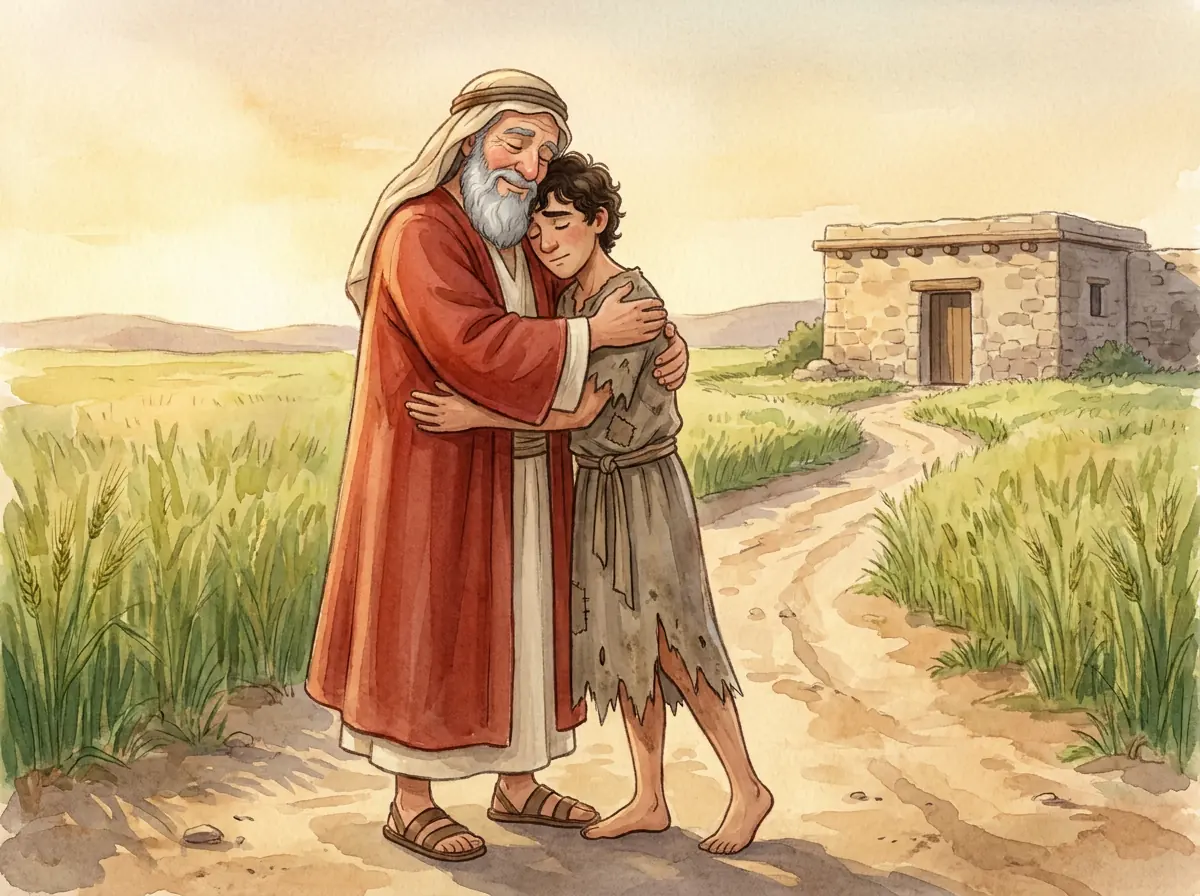
The Story of the Prodigal Son


“I will get up and go to my father, and will tell him, ‘Father, I have sinned against heaven, and in your sight. I am no more worthy to be called your son. Make me as one of your hired servants.’”
Luke 15:18–19
“Bring out the best robe, and put it on him. Put a ring on his hand, and shoes on his feet. Bring the fattened calf, kill it, and let us eat, and celebrate; for this, my son, was dead, and is alive again. He was lost, and is found.”
Luke 15:22–24
“But it was appropriate to celebrate and be glad, for this, your brother, was dead, and is alive again. He was lost, and is found.”
Luke 15:32
Quotations from the World English Bible (public domain). Read the full passage together in your own family Bible. The reference is Luke 15:11–32.
“…while he was still far off, his father saw him, and was moved with compassion, and ran…”
Luke 15:20
Jesus told this story to show us what God is like. Picture the father running down the road as you learn it.
World English Bible.
God is like the father in Jesus' story. When we turn back to Him, He welcomes us home with open arms and great joy.
- 01The shape of the story (running away, things going wrong, and being welcomed home anyway) is one every child understands in their bones.
- 02The father running down the road to hug his son is one of the most vivid pictures in all of Jesus' parables.
- 03The party ending, with the robe, the ring, and the music, makes forgiveness feel like joy instead of a lecture.
- 04Even the angry older brother is treated kindly, which comforts children who secretly relate to him.


Teach Bible stories at home or in the classroom.
Our Bible Story Lessons Starter Pack has twelve printable lessons for home or church. Try the Noah’s Ark lesson free: seven printable pages, sent to your inbox. See the Starter Pack →
We’ll also send a few emails over the next couple of weeks with lessons, printables and our books. Unsubscribe anytime.

The kind of things parents wonder.
What does “prodigal” mean?
Prodigal means wastefully extravagant, someone who spends everything recklessly. The word never actually appears in Luke 15; it is the traditional title the story picked up over the centuries. For kids, “the son who wasted everything” gets it across. Some teachers point out the father is extravagant too, recklessly generous with his love, which is why the story is sometimes called the parable of the loving father.
Why did the father run?
In that time and place, a dignified older man simply did not run. He would have to hitch up his robes and let the whole village watch, which was considered embarrassing. That is exactly the point. The father gladly looks undignified so his son doesn't have to walk the last stretch of shame alone. The running is a picture of grace: God doesn't wait for us to earn our way back. He comes to meet us.
Is the older brother the bad guy?
No. The older brother is angry, but the father loves both sons, and the story shows him going out to the older one just as he went out to the younger. Jesus told this parable to people who were grumbling about who deserved God's welcome, so the older brother is really a gentle question mark aimed at the listener: will you come in to the feast too? The story ends with the invitation still open.
Why was the son feeding pigs?
For the Jewish families listening to Jesus, pigs were unclean animals, ones they would not eat or even touch. So a son of Israel feeding pigs, and longing to eat the pigs' pods, was rock bottom: the lowest place the listeners could imagine. Jesus chose that detail on purpose, because the story is about how far the father's love reaches, all the way down to the muddiest, farthest-away place.
What is the main lesson of the Prodigal Son for kids?
That God's love does not run out when we get things wrong. The son hoped, at best, to be a hired servant; instead his father ran to him, hugged him, and threw a feast. Children learn that saying sorry and coming home is always safe with God, and that real love celebrates the person who comes back.
What age is the Prodigal Son story good for?
It works for roughly ages 3 to 8. Preschoolers can follow the simple arc of leaving home and being welcomed back with a hug, while older children can dig into the pigs and pods, the father's undignified run, and the older brother's fairness complaint, which often mirrors questions they are already asking.
How do you explain the Prodigal Son to a child?
Tell it as a leaving-and-coming-home story and keep the father in view the whole way. A younger son asked for his share of the family money and went far away, where he spent all of it and ended up hungry and feeding pigs. He decided to walk home and say sorry, expecting to be treated like a hired worker. But while the son was still a long way off, his father saw him, ran to him, hugged him, and threw a party. If your child is very young, that is the entire story and it is enough. The sentence to leave them with: he was still far away when his father started running.
What is the moral of the Prodigal Son?
It is really the father's story more than the son's. Jesus told it to people who were complaining that He welcomed the wrong sort of company, so the moral aims straight at them: God's welcome is wider and quicker and more undignified than we expect, and grumbling about who gets in misses the party entirely. That is why the parable ends with the older brother still standing outside and the invitation still open. Jesus leaves the ending unfinished on purpose.
Where is the story of the Prodigal Son in the Bible?
Luke 15:11 to 32, in the New Testament. It is the third of three lost-and-found parables Jesus tells in one sitting, after the lost sheep and the lost coin, and it only appears in Luke's Gospel. Reading all three together in Luke 15 takes about six minutes and makes the pattern obvious even to a young child.
Why did the son decide to come home?
Hunger, at first. The text says he came to himself while he was starving among the pigs, and that his father's hired servants had bread to spare while he was perishing. So he rehearsed a speech: he would say he had sinned, that he was not worthy to be called a son, and ask to be made a hired servant. He was not walking home confident of a welcome; he was walking home because he had run out of everything else. That is worth telling children plainly, because it means coming back does not require having the right feelings first.
What do the robe, the ring, and the sandals mean?
The Bible does not stop to explain them, so it is best not to be too certain with children. What the scene shows is unmistakable even without an explanation: the son arrives with a servant's speech ready, and before he can finish it his father calls for the best robe, a ring for his hand, and shoes for his feet, which some translations render as sandals. That is how you dress a son, not a hired worker. The father answers the request to be a servant by publicly making him a son again. A child who has ever been given a hug instead of the telling-off they braced for already understands it.
Is the Prodigal Son a true story?
It is a parable, which means a teaching story Jesus made up to show something true, not a report of something that happened to a particular family. Children handle that distinction well when you compare it to a story you might tell at the dinner table to explain a point. The father in the story is not a real man from history. What he shows about God is completely true, and that is what Jesus wanted His listeners to walk away holding.
Conversation starters.
Questions to ask after you read together. No right answers, just good conversation.
The father saw his son while he was still far, far away. What did the father do when he saw him?
What did the son plan to say to his father as he walked home?
Have you ever done something wrong and felt afraid to say sorry? What happened when you finally did?
The older brother didn't want to come to the party. What would you have said to him at the door?
Teaching this story.
- 01Reenact the run. Have your child walk slowly down the hallway as the ragged son while you play the father, and when they are “still far off,” run to them with your arms wide and scoop them up. That physical memory of being run to is the whole parable; children ask to do it again and again, and they should.
- 02Some children are older brothers at heart, the rule-followers who notice fairness keenly. Don't brush past his complaint. Point out that the father comes out to him too and says “all that is mine is yours.” This story has open arms for both kinds of kids.
- 03For ages 3–5, keep it to leaving-and-welcomed-home: a boy left his father, things went badly, he walked home, and his father ran to hug him. The inheritance, the pods, and the older brother can wait until they're ready.
- 04Read it alongside the Lost Sheep. Jesus told these stories together in Luke 15, and children love spotting the pattern: something precious gets lost, someone goes looking, and finding it ends in joy every time.
The Long Road Home

Cut a dozen paper footprints and lay them in a winding line down the hallway. Walk them one way as the son leaving, saying out loud what he takes with him, then turn around and walk the same footprints back, slower, with empty hands. Stand at the far end and have the grown-up spot the child from a distance and run the last stretch. Most children want a second go, and the second time they usually want to be the father.
One More Place at the Table

Before dinner, lay an extra place setting with your child: plate, cup, napkin, the good fork. Leave it empty through the meal and talk about who the father in the story would have wanted in that chair. At the end, let your child clear it and say who in your family or neighbourhood they would want to fill it. It turns the parable into an invitation rather than a lesson, which is how Jesus left it.
Everything you need in one place.
Written for a parent at the kitchen table or a Sunday school helper with twenty minutes and a box of crayons.
Ages: 3 to 8. Threes and fours need only leaving, coming back, and the run. From about six a child can hold the pigs, the rehearsed speech, and the older brother's complaint at the same time.
Read together: Luke 15:11–32 (WEB)
- A dozen paper footprints cut from scrap paper
- One spare place setting from your own cupboard
Read all three lost things
- Read Luke 15:3 to 7, the lost sheep, and ask what the shepherd did when he found it.
- Read Luke 15:8 to 10, the lost coin, and ask the same question about the woman.
- Before you read the third one, ask your child to guess how it will end.
- Read Luke 15:11 to 24, stopping at the party.
- Ask what was the same in all three stories. Most children get there on their own: something precious goes missing, somebody goes looking, and finding it ends in a celebration.
Rehearse the speech, then interrupt it
- Read verses 18 and 19 and help your child learn the son's rehearsed line: Father, I have sinned against heaven, and in your sight. I am no more worthy to be called your son.
- Send them to the far end of the hallway on the paper footprints and have them start walking back, practising the line out loud.
- Play the father: spot them early, run, and hug them before they can finish it.
- Now read verses 20 to 22 and let them hear that this is exactly what the Bible says happened.
- Ask how it felt to be interrupted. That feeling is the parable.
If the conversation stalls
Short model answers for the questions above. They are a starting point to offer if a child shrugs, not a script to read out.
The father saw his son while he was still far, far away. What did the father do when he saw him?
He was filled with compassion, and he ran. He ran down the road to his son, threw his arms around his neck, and kissed him (Luke 15:20). Children usually remember the running first, and that is the heart of the parable: the father ran to his son.
What did the son plan to say to his father as he walked home?
He planned to say he had sinned and was no longer worthy to be called a son. He had a speech ready asking to be made a hired servant, which tells you exactly what he expected: to be let back onto the property but not back into the family. He got the opposite before he could even finish saying it.
Have you ever done something wrong and felt afraid to say sorry? What happened when you finally did?
This one is worth answering yourself first, briefly and honestly, before your child does. The parable works on children who already know the walk down the hallway with a confession in their mouth. What you want them to notice is that the fear was worse than the coming home.
The older brother didn't want to come to the party. What would you have said to him at the door?
Anything kind counts. Point out that the father did not shout at him or leave him out there; he came outside and talked to him and told him everything he had was already his. Jesus never tells us whether the older brother came in, which means the question is still being asked of whoever is listening.
Keep exploring.
Bible Stories in Chronological Order for Kids
See where this story fits in the full Genesis-to-Revelation reading plan: 27 stories in order with summaries, ages, and a free printable.
Browse →All Bible Story Books
Browse the full collection of recommended Bible story books for children of every age.
Browse →Kindergarten Bible Stories
Browse more simple Bible stories well-suited for children ages 5 and 6.
Browse →More stories: The Lost Sheep
Story 23 of 27 in the reading plan
These Bible story retellings are based directly on Scripture and written for children ages 3–8. Each page includes its Scripture reference so families can read the original passage together. Written and edited by Hannah Whitford. Quotations are verbatim from the World English Bible; each retelling is checked against the passage.